
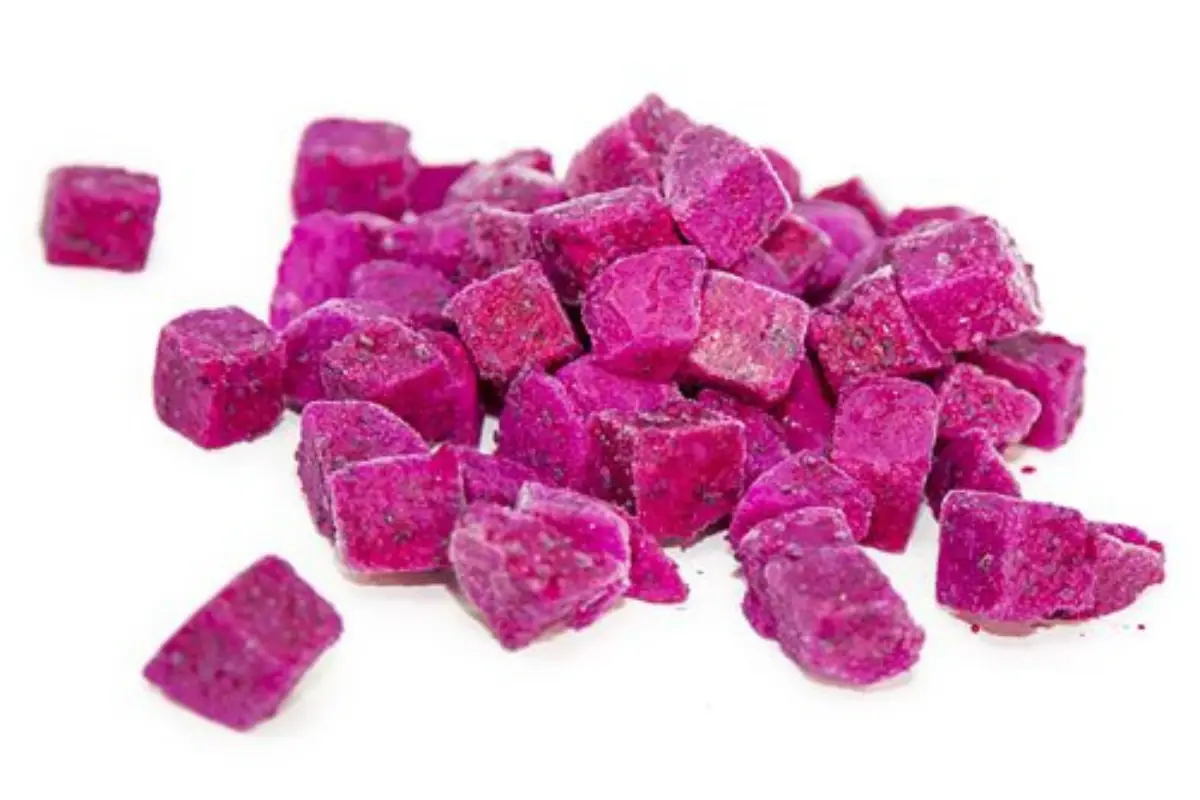

Thanks to its convenience in storage and processing, frozen dragon fruit is a suitable ingredient for beverage, food, and dessert businesses, especially for product lines that require a stable supply of fruit ingredients.
From a single fruit ingredient, businesses can develop a wide range of products, including smoothies, smoothie bowls, toppings, yogurt, ice cream, sorbet, and chilled desserts.
Depending on the intended use, dragon fruit can be prepared in chunks, diced pieces, larger cuts, or puree. Each format is suitable for different applications, from cafés and beverage shops to bakeries, hotels, and food processing manufacturers.
So, what can frozen dragon fruit be used for, and which product format should businesses choose for each application?
What Is Frozen Dragon Fruit and Why Is It Increasingly Used in the F&B Industry?
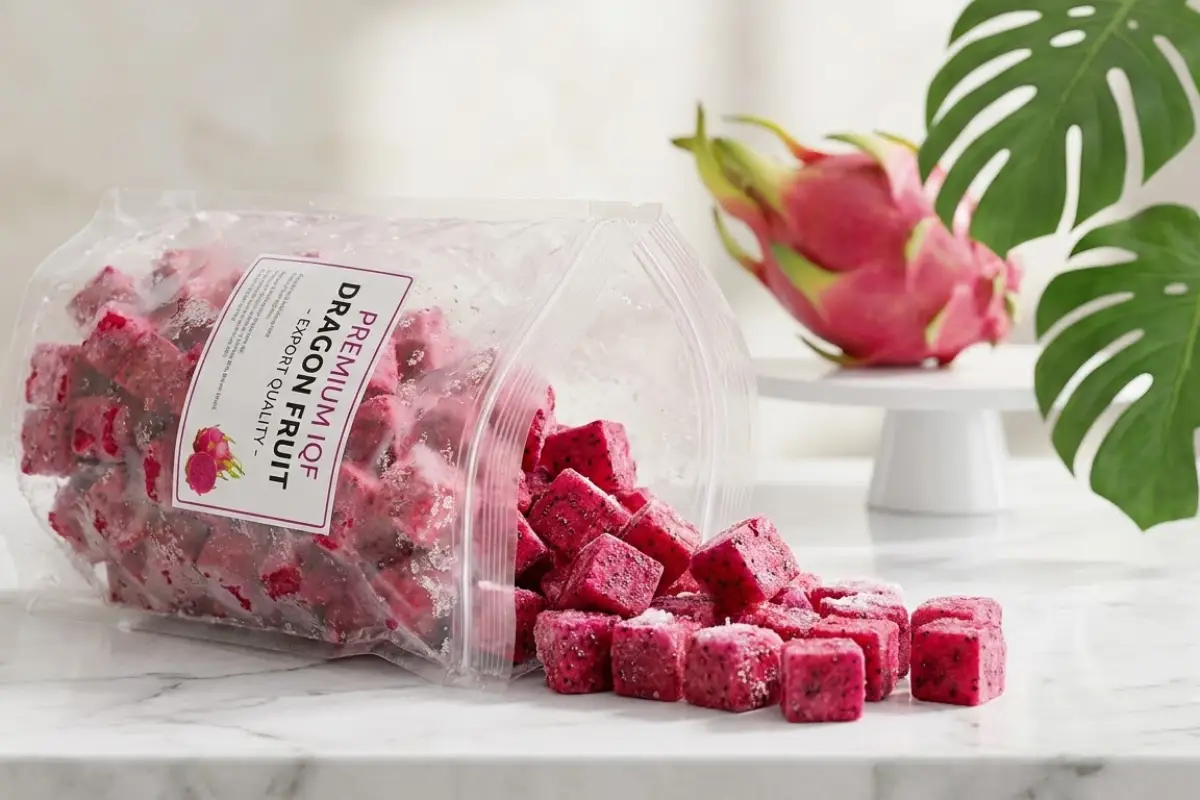
Frozen dragon fruit is dragon fruit that has been processed and frozen shortly after harvest to help preserve its color, flavor, and much of its nutritional value.
The product is commonly frozen using IQF (Individual Quick Freezing) technology, in which individual fruit pieces are rapidly frozen at very low temperatures. This helps prevent the pieces from sticking together, makes portioning easier, and helps maintain a more natural texture after thawing.
Depending on business needs, frozen dragon fruit can be supplied in different formats, including chunks, diced pieces, large cuts, or puree.
Businesses can also choose between red-fleshed dragon fruit and white-fleshed dragon fruit, depending on the recipe and desired characteristics of the final product.
What Is Frozen Dragon Fruit Used For?
1. Dragon Fruit Smoothies
Dragon fruit smoothies are one of the most common applications of frozen dragon fruit.
The fruit can be added directly to a blender together with milk, yogurt, fruit juice, or other fruits depending on the recipe. Using frozen fruit can help create a colder, thicker beverage without requiring too much ice.
Dragon fruit also pairs well with ingredients such as:
- Banana
- Mango
- Pineapple
- Yogurt
- Fresh milk
- Plant-based milk
Frozen red dragon fruit is often selected for recipes where visual appeal is important. Its naturally reddish-purple flesh can give beverages a more vibrant appearance, making it suitable for cafés, juice bars, and beverage chains.
Beyond a basic dragon fruit smoothie, businesses can also develop products such as dragon fruit banana smoothies, dragon fruit mango smoothies, or dragon fruit yogurt smoothies.
With the right combinations, one ingredient can support multiple menu options.
For beverage businesses, instead of focusing on just one dragon fruit smoothie recipe, it is useful to test different blending ratios to achieve the desired thickness, color, and flavor for the target customer group.
2. Smoothie Bowls
Frozen dragon fruit is also well suited for smoothie bowls, particularly for cafés, health-focused food businesses, and breakfast concepts.
Unlike drinkable smoothies, smoothie bowls generally require a thicker texture.
Dragon fruit can be blended with frozen banana or mango to create the base, then topped with ingredients such as granola, yogurt, chia seeds, dried coconut, or fresh fruit.
Red dragon fruit offers a clear visual advantage in this application. Its vibrant color can make the finished product more attractive, while its relatively mild flavor makes it easy to combine with different toppings.
For F&B businesses, smoothie bowls also provide another way to expand the use of the same ingredient rather than limiting dragon fruit to beverages only.
3. Toppings for Yogurt and Desserts
Not every application requires dragon fruit puree.
For yogurt, parfaits, fruit cups, and chilled desserts, diced or chunked frozen dragon fruit is often more suitable.
It can be used as a topping for:
- Yogurt
- Smoothie bowls
- Parfaits
- Fruit cups
- Cup desserts
- Selected beverages
The size of the fruit pieces is an important factor.
Yogurt toppings generally require smaller and more uniform pieces, while fruit intended for smoothies can be cut into larger chunks because it will be blended.
For this reason, businesses purchasing frozen dragon fruit for commercial use should consider the product specification and cut size, not only the type of fruit.
4. Dragon Fruit Ice Cream and Sorbet
Dragon fruit is also suitable for ice cream and sorbet applications, especially red dragon fruit or dragon fruit puree.
The ingredient can be used in products such as:
- Dairy ice cream
- Sorbet
- Frozen yogurt
- Chilled desserts
For recipes requiring a smooth and uniform texture, dragon fruit puree is often more convenient because it can be blended easily with other ingredients.
By contrast, dragon fruit chunks can be used as fruit inclusions or toppings.
In commercial production, developing dragon fruit ice cream depends not only on the fruit ratio but also on factors such as sugar content, fat content, total solids, and the desired final texture.
Businesses should therefore test recipes on a smaller scale before moving to larger-volume production.
5. Mousse, Pudding and Chilled Desserts
Dragon fruit is also suitable for many dessert applications that do not require intensive heating.
Examples include:
- Dragon fruit mousse
- Pudding
- Panna cotta
- Jelly
- No-bake cheesecake
- Fruit cups
- Cup desserts
In these applications, dragon fruit puree and diced dragon fruit serve different purposes.
Puree is generally more suitable for sauces, fruit layers, or direct incorporation into mousse mixtures.
Diced dragon fruit is more suitable when visible fruit pieces are desired in the finished product.
These applications are also suitable for restaurants, hotels, and businesses specializing in desserts.
6. Bakery Applications
Dragon fruit is not a traditional bakery ingredient, but it can still be used to develop products with fruit elements or distinctive visual appeal.
Possible applications include:
- Fruit fillings
- Mousse cakes
- Cheesecakes
- Fruit jelly layers
- Sauces
- Glazes
- Toppings
Dragon fruit puree is generally more suitable for recipes requiring a smooth and uniform mixture, while chunks can be used as toppings or fruit inclusions inside baked or chilled products.
For red dragon fruit, its natural color can also be an advantage when businesses want to create products with stronger visual identity.
However, each bakery recipe has different requirements for moisture, texture, and heat stability.
Businesses should therefore test the ingredient for each specific application instead of using the same ratio across all recipes.
7. Sauces, Beverage Bases and Food Processing Ingredients
In addition to direct use, frozen dragon fruit can also serve as a raw material for further food processing.
Applications may include:
- Dragon fruit puree
- Beverage bases
- Fruit sauces
- Yogurt ingredients
- Ice cream ingredients
- Fruit fillings for bakery products
- Desserts
- Mixed fruit products
These applications are particularly suitable for food manufacturers, F&B ingredient suppliers, and businesses that process products at larger volumes.
Instead of purchasing fresh fruit and carrying out all preparation steps in-house, using fruit that has already been processed to the required specification can help make production more convenient and consistent.
Should You Choose Dragon Fruit Chunks or Puree?
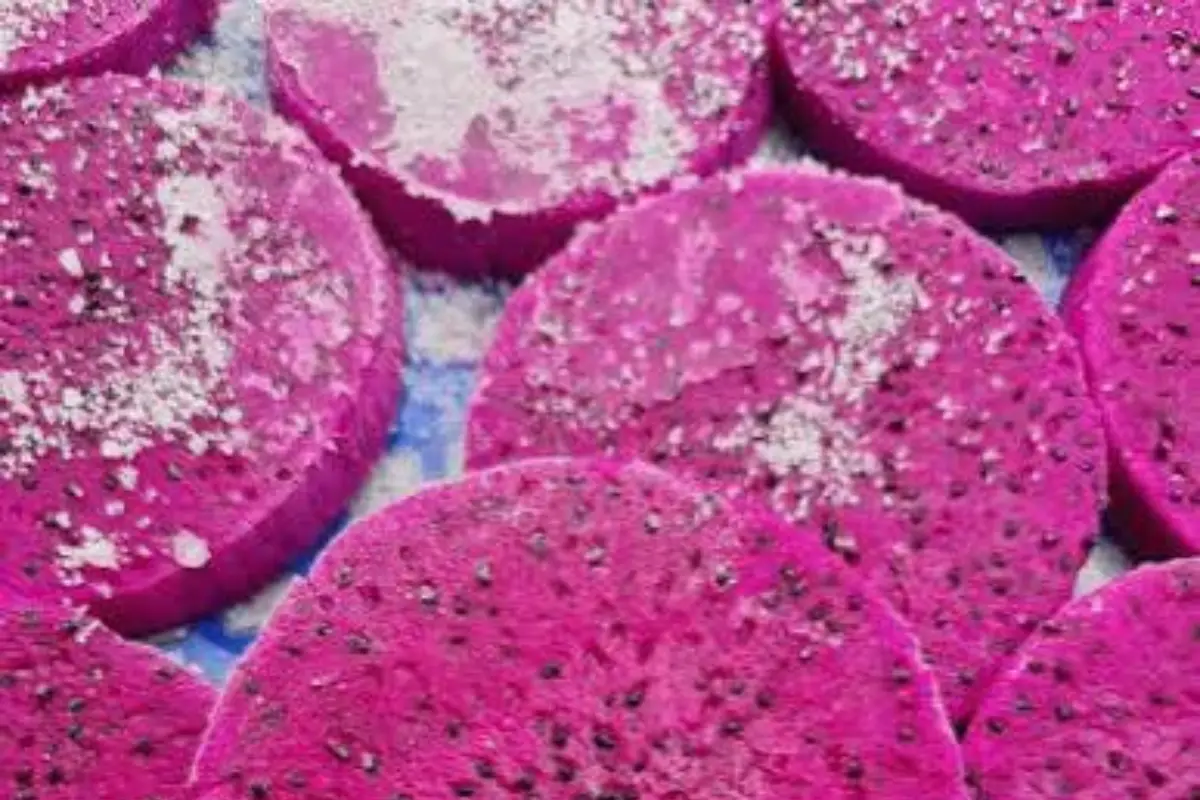
The most suitable format should be selected according to the final application.
| Ingredient Format | Suitable Applications |
|---|---|
| Chunks | Smoothies, blended beverages |
| Diced pieces | Yogurt, toppings, desserts |
| Puree | Sauces, ice cream, sorbet, bakery |
| Large cuts | Restaurants, desserts, further processing |
If a business mainly produces dragon fruit smoothies, chunks are often convenient for portion control and preparation.
For ice cream, sauces, or bakery fillings, puree may be more suitable because it eliminates an additional processing step.
Therefore, when sourcing frozen dragon fruit, businesses should first define the intended application, required cut size, and desired characteristics of the final product.
Does Frozen Dragon Fruit Need to Be Thawed Before Use?
Not every application requires frozen dragon fruit to be completely thawed before processing.
For smoothies and smoothie bowls, the fruit can be used while still frozen to create a colder and thicker texture.
For toppings, yogurt, or desserts, the degree of thawing should be controlled according to the desired texture. If the fruit is left thawed for too long, the texture of the pieces may change.
For bakery applications or sauce production, ingredient handling should follow the specific formulation and processing method of each product.
In commercial production, businesses should establish handling guidelines for each product line to maintain consistency between batches.
What Types of Businesses Can Use Frozen Dragon Fruit?
Frozen dragon fruit can be used directly or as an ingredient for further processing, depending on the requirements of the final product.
According to TCVN 13939:2023 on frozen dragon fruit, the product is specified for both direct consumption and further processing.
For cafés and beverage shops, frozen dragon fruit can be used in smoothies, blended drinks, and smoothie bowls.
For yogurt and dessert businesses, diced fruit or puree can be used for toppings, sauces, and fruit layers.
Restaurants, hotels, and foodservice businesses can use dragon fruit in beverages, desserts, or menu-based applications.
Meanwhile, bakeries and food manufacturers can use dragon fruit puree or chunks as ingredients in fillings, mousse, ice cream, sauces, and other fruit-based products.
Red Dragon Fruit or White Dragon Fruit: Which Is More Suitable?
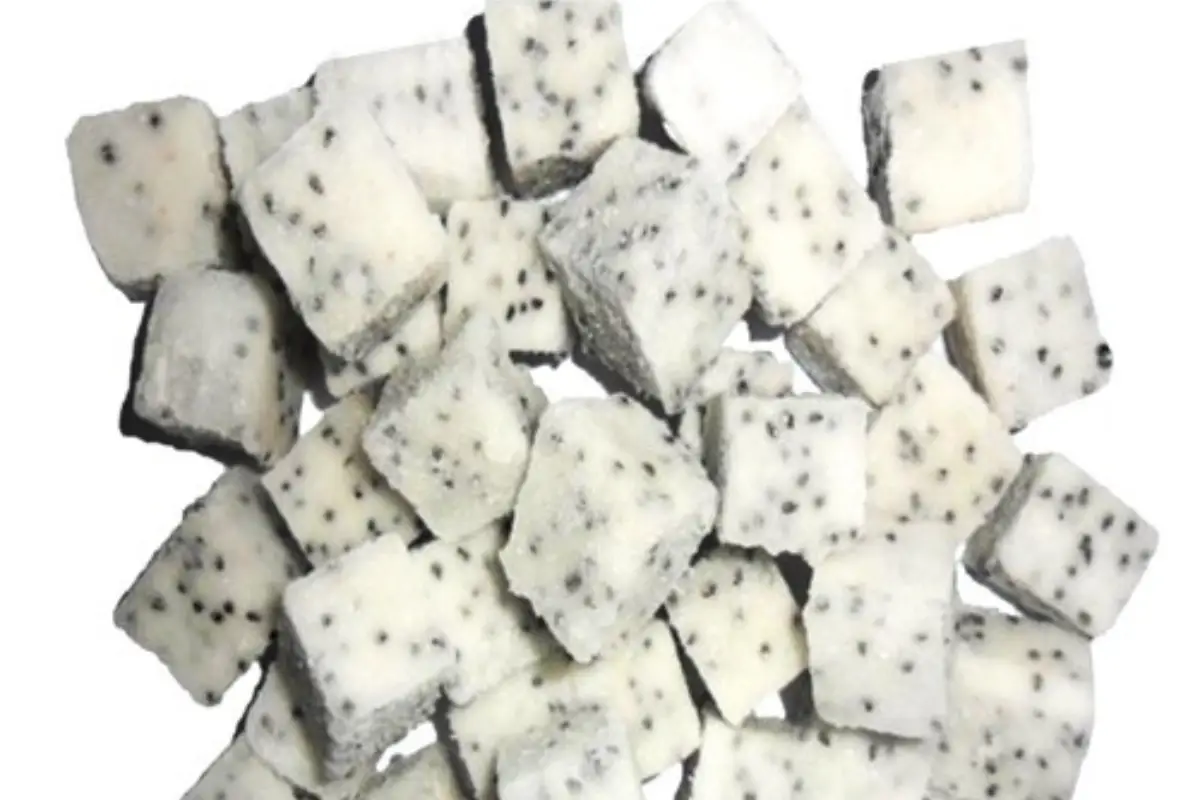
Frozen red dragon fruit is often selected for smoothies, smoothie bowls, sorbet, sauces, and desserts when the color of the final product is an important factor.
White dragon fruit has a more neutral appearance and may be better suited to recipes that combine multiple ingredients or products that do not require a highly vibrant color.
Neither variety is suitable for every application.
Businesses should select the appropriate type based on the formulation, desired color, and characteristics of the final product.
Important Considerations When Using Frozen Dragon Fruit
To use frozen dragon fruit effectively in F&B operations or food processing, businesses should consider the following:
- Store the product at the temperature recommended by the supplier.
- Maintain the cold chain during transportation and storage.
- Avoid repeated thawing and refreezing.
- Select the appropriate cut size for the intended application.
- Establish ingredient usage standards for each recipe.
- Conduct product trials before moving to large-scale production.
These practices can help businesses achieve better control over final product quality and reduce variation between production batches.
Frozen Dragon Fruit: A Versatile Ingredient for Beverages and Desserts
From dragon fruit smoothies, smoothie bowls, and toppings to yogurt, dragon fruit ice cream, sorbet, bakery products, and desserts, frozen dragon fruit can be used across a wide range of food and beverage applications.
The key is to choose the right ingredient format from the beginning.
Chunks are suitable for blended beverages, diced fruit is convenient for toppings, while puree is more suitable for sauces, ice cream, and formulations that require a smooth and uniform mixture.
For F&B businesses, distributors, importers, and food processors, clearly identifying the required specification, intended application, and technical requirements can make product development more efficient.
VILIFA supplies frozen fruit products from Vietnam for distribution, foodservice, and food processing applications.
Businesses looking for information about frozen dragon fruit, product specifications, packaging options, or export details can contact VILIFA for consultation based on their specific sourcing and application requirements.